
Where Do I Start?
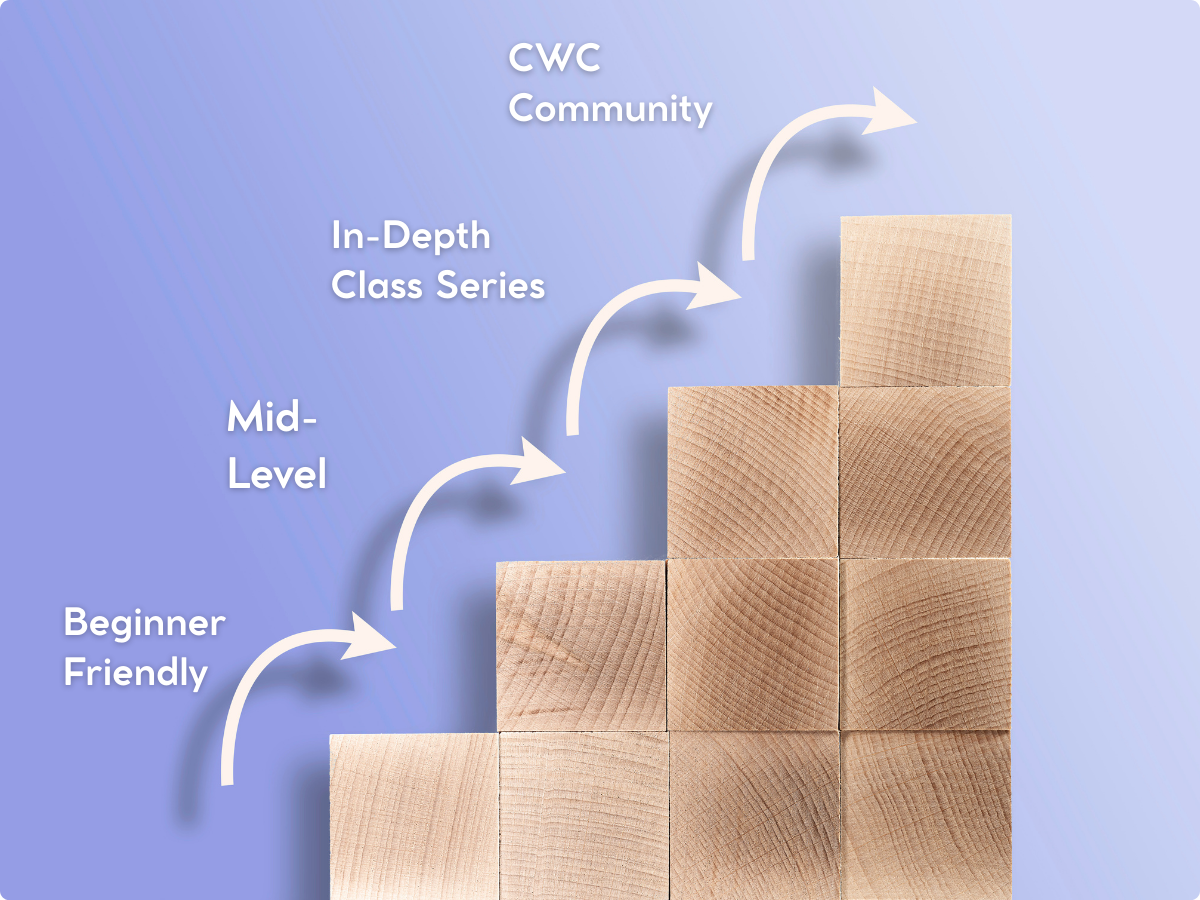
CWC hair color education is organized in 3️⃣ main learning phases. You don’t have to start at the beginning. You can start where you are. This page will help you find your best starting point in 3 simple steps...
Step 1: Fill out the 2 minute color check-in below.
Step 2: Submit your answers to get the class recommended for you.
Step 3: After your class, when you're ready, move to the next phase.
✨ Head to the 2 min check-in below for class guidance.
The 2 Min Color Check-In ⤵️
2-Minute Class Readiness Check
Take this quick check-in and we'll point you to the phase you're most ready for.
Start too far ahead and it can feel overwhelming. Start too far back and you may not feel challenged.
Take a quick check-in to make sure you're starting at the level that's right for you.
Choose Your Learning Path

Phase 1Beginner Friendly Classes
Build your foundation
- What color actually is
- Hue, level, and chroma
- The basics of the wheel
- Hair fiber and pH basics
- 5 basic ways tone shifts
- Thinking through formulation
Phase 1Beginner Friendly Classes
Build your foundation
This phase gets you grounded in the basics of color and color mixing. When your baseline is solid, the rest feels clearer, more doable, and less overwhelming.
Next step: Mid-Level Classes or In-Depth, depending on where you are.

Phase 2Mid-Level Classes
Learning to build tones
- See how tones shift as they mix
- Recognize what influences the final color
- Understand what’s in your tube
- Use the wheel to guide tone choices
- Build tones with more clarity and purpose
Phase 2Mid-Level Classes
Learning to build tones
This phase helps close deeper understanding gaps and strengthens the skills that move you from knowing concepts to applying them more confidently.
Next step: The In-Depth Class Series.

Phase 3In-Depth Class Series
The complete system
- Foundations of color theory
- Hair color chemistry
- Directional Color Mapping™
- Formulating with purpose
- More predictable color decisions
Phase 3In-Depth Class Series
The complete system
You’ll get the education, build practical skills, and organize it all into a process so you can formulate with more confidence, clarity, and purpose.
Includes access to the CWC Community for continued practice, feedback, and support.

Included with In-DepthThe CWC Community
Practice, feedback, and support
- Feedback on activities
- Guided skill-building
- Ask your after-class questions
- Ongoing support and accountability
- A community on the same path
Included with In-DepthThe CWC Community
Practice, feedback, and support
This is where in-depth students keep building through feedback, questions, practice, and support. It helps close the gap between getting information and using it with more confidence behind the chair.
Access included when you take a CWC live In-Depth Zoom class.
For Stylists At Different Places On Their Color Journey
We get asked this question a lot.
If you’re already doing good hair, why would you come learn this?
And I’ll be honest, we actually have a lot of seasoned stylists come to see us. More are seasoned stylists than newer ones.
We’ve asked ourselves the same question. Why are they coming?
Here’s what they tell us.
They’re getting good results.
A lot of the time, their color works.
They’ve been around for years. They know the typical things we all learn in this industry. They’ve taken brand classes. They’ve built experience.
But every once in a while, something doesn’t go the way they expect.
And when that happens, they don’t always know why.
They can usually fix it.
They can usually work around it.
They can usually get the client where they need to go.
But they’re still left wondering,
“What actually happened there?”
“Why did that work this time but not last time?”
If you look through our reviews, you’ll see a lot of seasoned stylists saying exactly that. People who’ve been doing hair for 20, 30 years, talking about how this changed the way they think about color, not because they were bad at it, but because they wanted clarity they could trust.
What they tell us is that they’re tired of relying only on habit or familiarity.
They want to understand what’s actually happening so they can predict results, not just react to them.
They want to be able to look at a situation and say, “Okay. I know why this happened.” And, “I know what to do next.”
That’s why seasoned stylists come to us.
Not because their color is bad.
But because they want understanding that holds up, across different clients, different situations, and different color lines.
You can read what some of them had to say HERE
The newer stylists tend to ask the opposite question as the seasoned stylist. The seasoned stylists ask, "why would I need this?"
The newer stylists tend to ask,
“I’m newer. Can I even learn this yet?” “Is this too much?”
“Should I wait until I have more experience?”
And the honest answer is no, you don’t need to wait.
We see newer stylists come into this work and absolutely get it. Stylists are naturally some of the most genuinely smart, curious, thoughtful people.
We’ll tell you about Lola.
Lola’s about three years into doing hair. She’s taken two classes with us. That’s it. Just two.
She’s going to out-formulate a lot of seasoned stylists very quickly. She already is!
But it’s not because she’s smarter than everyone else. It’s not because she’s a quicker learner than everyone else, although she is a pretty smart cookie.
It’s just because she learned this earlier and she's practicing what she's learned in order to build up her skills.
And that’s the difference.
We caught her early.
We gave her what she needed early.
We didn’t oversimplify it.
We didn’t assume she couldn’t understand it.
So this became how she thinks about color.
She understands what’s in the tube.
She understands how color mixes.
She understands why something behaves the way it does.
And this is why we fight for this information to be given to newer stylists sooner.
Because we know it changes things.
It makes it easier for them to understand what they’re doing faster.
It helps them struggle less.
That’s the whole point.
If You Want MORE Than A Quick Check-In...
This 8-12 min self assessment will help you take a deeper look at where you're strong and where your edu gaps might be hiding
.png)