
Developing Your Color Skills
You can't develop your color skills unless you slow down, make sense of what you've been taught, build your thinking, & develop the skills that lead to better color results
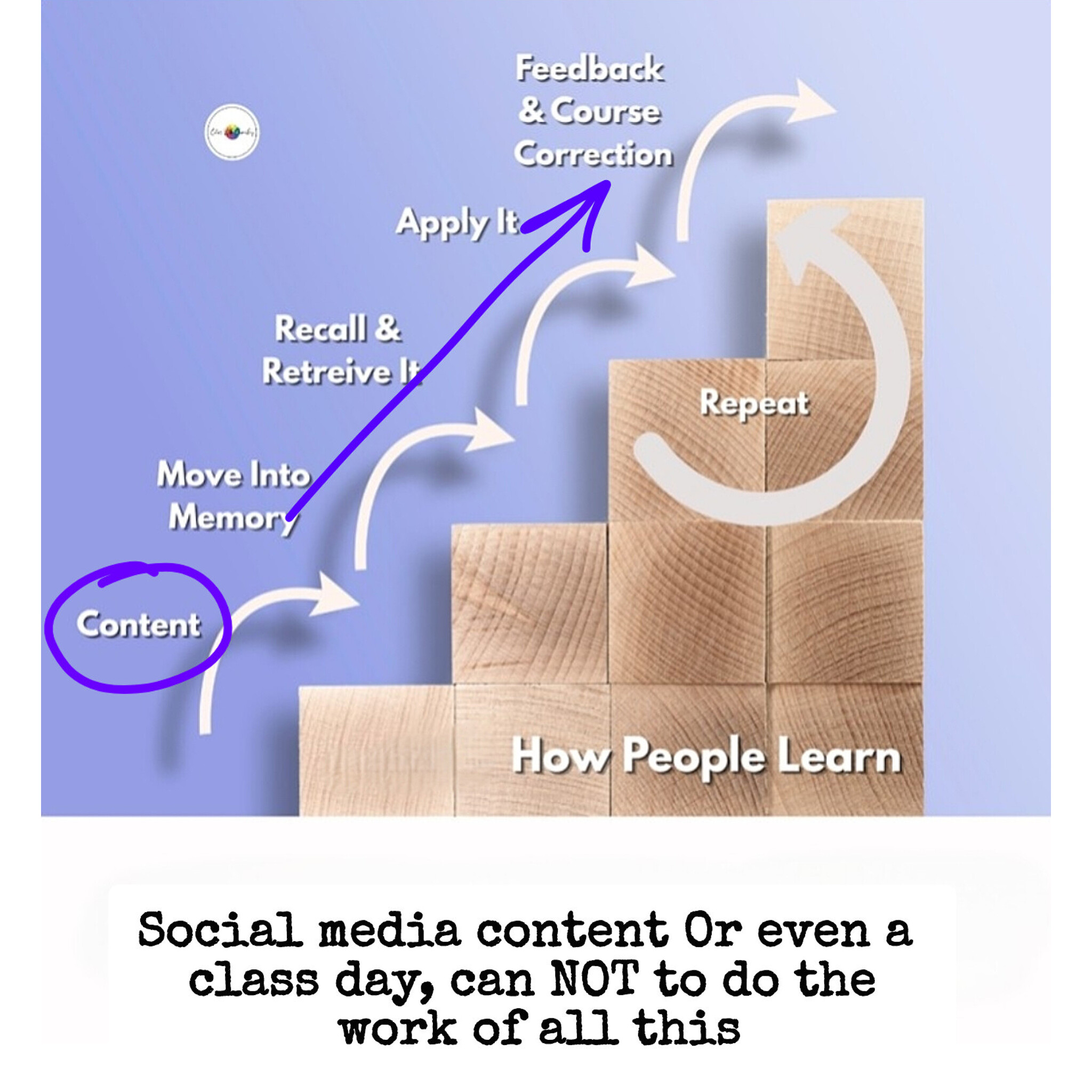
Taking in information isn’t the same as learning & developing the skill to do it.
Do you see all the phases in that picture up there? It’s what we all go through when we’re actually learning something.
They might look like separate steps, but they’re really connected. You take in the information, start making sense of it, work with it, try to remember it, use it, get feedback, go back to pieces you missed, and keep working with it until it becomes something you can actually use.
That can get missed in hair education.
A lot of the time, we get introduced to a concept and then we’re expected to go straight back behind the chair and somehow know what to do with it in real time. That's not always what happens.
So what do we do?
We go find more information. Another class, post, reel, chart, formula.
All of that can be helpful, but more information still doesn’t automatically turn into learning.
Content gives you ideas, concepts, language, and information you may not have had before.
Sometimes you hear something and immediately think, “Ohhh...that makes sense!”
But something making sense while you’re hearing it still isn’t the same as being able to pull it up later, work through it, and use it on your own.
You can get really familiar with something by hearing it over and over.
You can recognize the words, know the example, follow right along while someone's teaching it.
And then you get behind the chair with a completely different head of hair in front of you and think, “Wait. How do I use it here?”
That's a gap.
Learning is when you can retrieve what you learned, work with it, make a decision with it, and keep doing it without needing someone to walk you through every step.
And that takes more than exposure to information or content. It takes working with it, practicing with it.
And it takes helpful feedback while you’re still figuring it out.
Information is content that's available.
Learning is being able to use it independently, and hold onto it over time.
There’s even a stage in between where you can do something, but only with the right prompts or with someone helping walk you through it.
We see that one all the time.
A stylist can sit in a class, understand the material, answer the questions, and still not be ready to use all of it independently the next day.
That doesn’t mean the class was bad or it didn't work. It just means the learning isn’t finished yet.
If you want what you’re learning to actually stay with you and become part of how you think behind the chair, you have to keep working with it.
Your experience matters a lot.
Years behind the chair can sharpen your eye, build pattern recognition, and teach you things through repetition that no book or class could ever give you.
But experience can’t fill in information you were never taught.
If nobody ever gave you the why, the full concept, or a framework that helps all those pieces come together, years behind the chair don’t magically fill that in.
That’s why someone can be years into doing beautiful hair and STILL feel like there are pieces of color they never completely understood.
Your years in don’t tell us what stage of learning you’re in, they just tell us you have experience.
And that experience is incredibly useful once you have the missing information to connect it to.
Content gives you theory, concepts, and knowledge that experience alone may never teach you. Experience gives you pattern recognition and real situations to apply that knowledge to.
You need both! Neither one does the whole job by itself.
And then there’s practice.
Not just doing more color, but actually working with what you’re learning, checking your thinking, getting feedback, and course correcting while you go.
That’s how something starts becoming usable.
This is also why we define “helpful” a little differently at CWC.
Sometimes helpful means giving you the answer you need right now. "Tell me what to put in my color bowl."
We get it. You’ve got a client sitting in your chair and sometimes you just need an answer. But if that’s the only kind of help you get, you’re right back looking for another answer the next time a situation changes.
To us, the bigger and better kind is helping you understand enough that you can start working through the the decisions yourself.
Every answer shouldn’t have to come from someone else's thinking.
One keeps you going back to social media, formulas, charts, and other people every time you get stuck. The other helps you build your own thinking.
And that’s why our classes are built the way they are. They're designed to work with how stylists learn, creatives included!
We don’t expect you to hear something once in a class and suddenly know how to use all of it behind the chair.
You'll get the information, the whys & hows first.Then you'll work with it.
You have workbooks that become your resource guides and activities. You'll go back through pieces that didn’t quite stick the first time. You'll start trying it in real situations, ask questions, get feedback and course correct.
And little by little, the content you took in starts showing up in the way you actually think through color.
THAT'S the goal of education. Being able to use it when you need it.
CWC Classes Are Designed To Work With How Stylists Learn
